DDD demystified: a pragmatic approach to large systems
What is Domain-Driven Design, and when is it worth using? We explain the pillars of DDD, the role of Ubiquitous Language, Bounded Context and Model-Driven Design, and how DDD helps build large, agile applications.
Tomasz Soroka
What is Domain-Driven Design?
Domain-Driven Design (DDD), proposed by Eric Evans in 2003, is an approach to software development that starts with a deep understanding of the business domain. Its goal is to align the system model with the company’s real processes and concepts in order to eliminate the communication gap between technical teams and business experts. According to Statista, in 2020, 49.9% of developers declared using DDD in their daily work.
DDD helps teams tackle the complexity of large and sophisticated systems. By modelling reality faithfully, it enables software that better delivers on business goals and adapts more quickly to strategic change. It is not a universal formula, but an approach tailored to a specific domain.
A University of Stuttgart study indicates that a shared understanding of the domain within the team has a crucial impact on project success — 36% of the analysed projects succeeded for precisely this reason.

Why DDD matters in large applications
In complex environments, dependencies, fragmented ownership and the volume of change all increase. DDD brings order to these challenges through precise terminology, clear model boundaries and iterative refinement of business logic. The result is better communication, greater architectural consistency and a lower risk of costly misunderstandings.
Key elements of DDD
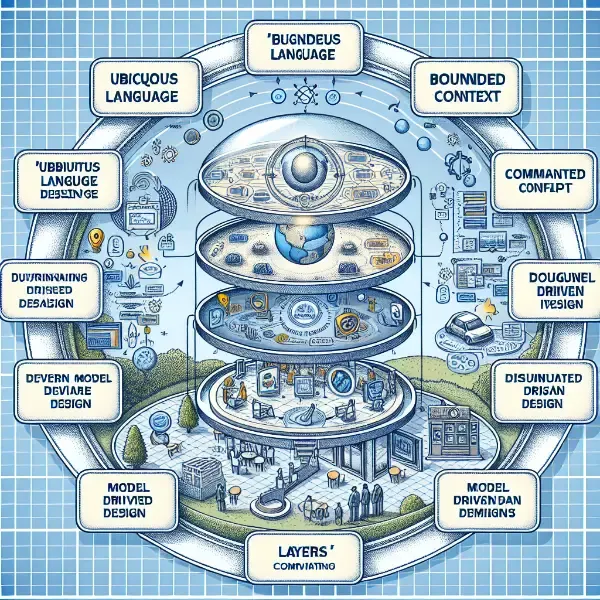
The effectiveness of DDD is supported by four pillars: Ubiquitous Language, Bounded Context, Model-Driven Design and Layers. In 2021, 37.1% of IT specialists indicated DDD as their preferred software development strategy (Polling Strategies).
- Ubiquitous Language: a shared language used by business and IT in conversations, documentation and code, giving the model precision and credibility. Cambridge University research links 78% of successful collaborations to an agreed conceptual language.
- Bounded Context: clearly defined boundaries within which a given model and language apply. It separates the meanings of concepts and simplifies integrations. IEEE reports higher efficiency (72.5%) in applications with well-defined contexts.
- Model-Driven Design: design led by a domain model that faithfully reflects business rules and is continuously refined as new knowledge emerges. Harvard Business Review recorded a 28% increase in project completion rates when this practice is applied correctly.
- Layers: application layering (e.g. presentation, application, domain, infrastructure) organises responsibilities and makes maintenance easier. Stack Overflow analysis associates layered architecture with a 35% improvement in maintainability.
Examples and outcomes in practice
Companies around the world use DDD to streamline processes and improve communication between business and IT. According to The Voxeo Blog, Voxeo Corporation recorded a 45% increase in software efficiency after implementing DDD, particularly thanks to Ubiquitous Language and improved Model-Driven Design.
Standardising the language enabled the Voxeo team to create a model closely aligned with business needs, which translated into a 32% improvement in process efficiency over two years.
In practice, the most commonly reported benefits of DDD include faster product decision-making, easier requirement changes, a more modular architecture, and stronger alignment between solutions and company goals.
Summary
DDD is a pragmatic way to build large systems: it structures language, defines boundaries and guides design through the domain model. As a result, software becomes a faithful reflection of business strategy, and teams deliver valuable features more quickly.
Need technology support?
Let’s talk about your project — from discovery to deployment.
Book a consultationWould you like to know more?
Explore other articles or let’s discuss your project
All articles Let’s design your AI application