From sketch to success: the recipe for an effective MVP
A practical guide to building and launching an MVP: from research and selecting key features, through prototyping and the Build-Measure-Learn loop, to implementing feedback, launching the product and preparing for scaling.
Mateusz Kopta
The foundation of an MVP in a startup
The journey does not begin with code, but with understanding the market. An MVP, or Minimum Viable Product, is the smallest useful version of a product that allows you to test a business hypothesis with real users.
The key is identifying a genuine need. Market research, conversations with potential customers and concept testing in focus groups help confirm that the problem exists and is worth solving. Only then do you have a real starting point.
The next step is to visualise the solution and gather feedback quickly. Based on it, you refine the scope and select only those features that deliver the greatest value to the first users. This kind of focus creates a solid foundation for iterative development and growth, in line with the spirit of the guide From Idea to MVP: A Non-Tech Founder's Blueprint.
How to build an effective MVP
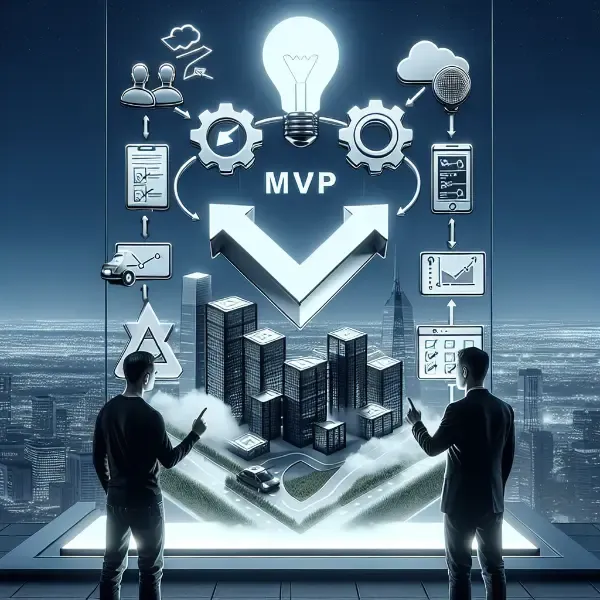
An effective MVP is not a stripped-down copy of the target product, but a deliberately simple, working increment that validates the most important business thesis with the minimum possible investment in features and cost.
The less is more approach brings three benefits: faster delivery, budget savings and early detection of technical risk. At the same time, it opens the way to deliberate product development based on hard user data.
- Define one main hypothesis and success metrics (e.g. activation, retention, conversion rate) - Choose 3–5 critical features that prove the value of the solution - Move nice-to-have features to the backlog for later - Ensure basic analytics and telemetry to measure user behaviour - Plan iterations around feedback, not team assumptions
Agility and a tight feedback loop are crucial here. This way of working aligns well with the conclusions from Blazing Fast: Leveraging Blazor 8 for MVP Development, which highlights the importance of rapid cycles and responding to data.
Strategy and timeline for MVP work

The roadmap from sketch to first version requires a combination of vision and pragmatism. The schedule is not a straight line, but a planned Build-Measure-Learn loop.
- Research: understanding the problem, user segments and their priorities - Prioritisation: selecting key use cases and the minimum feature set - Prototype: quick mock-ups or a clickable model for early validation of the direction - MVP implementation: only what is needed to test the hypothesis and measure metrics - Testing and iterations: cyclical improvements driven by qualitative and quantitative data
Avoid the trap of being everything to everyone. Focus on what delivers the greatest value to the defined target group. This approach is consistent with the lessons from Navigating the Turbulent Waters of Software Development, where the emphasis is on consciously limiting scope and learning continuously.
User feedback in practice
The most important moment on the journey from sketch to success is implementing feedback into the MVP. You turn qualitative and quantitative data into concrete product decisions that improve product-market fit.
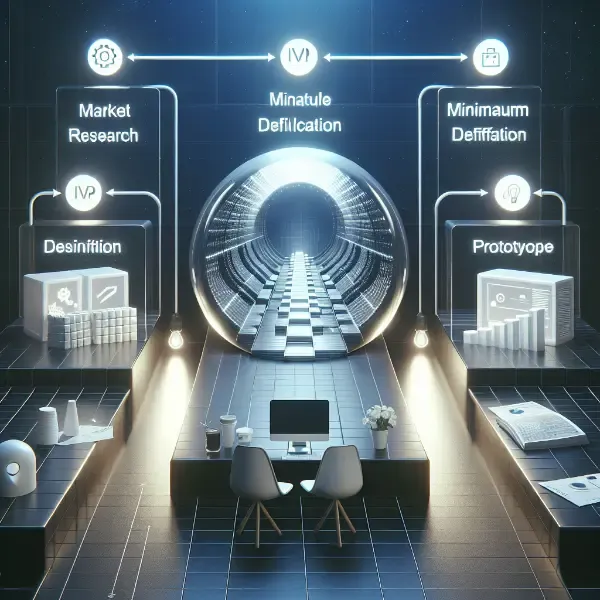
- Information-gathering channels: interviews, surveys, NPS, in-product behaviour analysis, heatmaps, support - Technical structure: flexible architecture and modular code that make rapid changes easier - Quality: rigorous testing and monitoring so that every iteration is safe and predictable - Collaboration: involve stakeholders in the feedback loop and organise insights in the backlog - Decisions: balance user wants with technical feasibility and business goals
Such a comprehensive strategy, aligned with the conclusions from Unlocking Success: Validating Market Needs Before Launching Your MVP, allows you not only to meet expectations, but to exceed them.
Launching an MVP: from validation to growth
When validation of the first version confirms its value, it is time to enter the market and prepare for scaling. This is the stage at which you combine insights from testing with a clear growth plan.
- Refine the value proposition based on proven user benefits - Show investors and partners hard evidence of market fit: metrics, case studies, feedback - Plan the go-to-market: acquisition channels, pricing, onboarding, support - Build an iteration rhythm after launch: regular releases, a data-driven roadmap, A/B experiments
An MVP launch is not the end, but the beginning of a cycle of learning, adaptation and growth. It combines timeline strategy with ongoing improvements, creating a solid track for long-term growth. In this context, practical guidance on how to plan and execute an MVP launch will be useful.
Do you need technology support?
Let’s talk about your project — from discovery to implementation.
Book a consultationWould you like to know more?
Explore other articles or let’s discuss your project
All articles Let’s design your AI application