Starting without tech: how to launch a technology startup without an IT background
No technical education? That’s not a problem. See how vision, leadership and smart choices can help you build a startup, how the pace of startups differs from that of corporations, and what role VC plays.
Tomasz Soroka
Entering the world of technology without a technical background
A common myth says that only engineers succeed in tech. The reality is different: around 33% of technology startups are founded by people without a technical background. They combine sharp business instinct, strong leadership and a clear vision — and make up for their lack of coding skills in this way.
An example? Brian Chesky was not a programmer when he created Airbnb. He used creativity, determination and a marketplace model with network effects to revolutionise the accommodation industry. There are many similar stories — technology is an important element, but only one of many in the puzzle of scaling a company.
It has also never been easier to catch up on the basics. Platforms such as Codecademy and Treehouse offer beginner courses, while meetups, webinars and mentoring programmes shorten the learning curve. Even a general understanding of languages and the mechanics of product development makes it easier to talk to a technical team and make decisions.
The conclusion is simple: success is determined by vision, execution and consistency. There is no single recipe for a breakthrough — it requires the courage to challenge the status quo and learn faster than the market.
Startup vs mature company: a different rhythm and different priorities
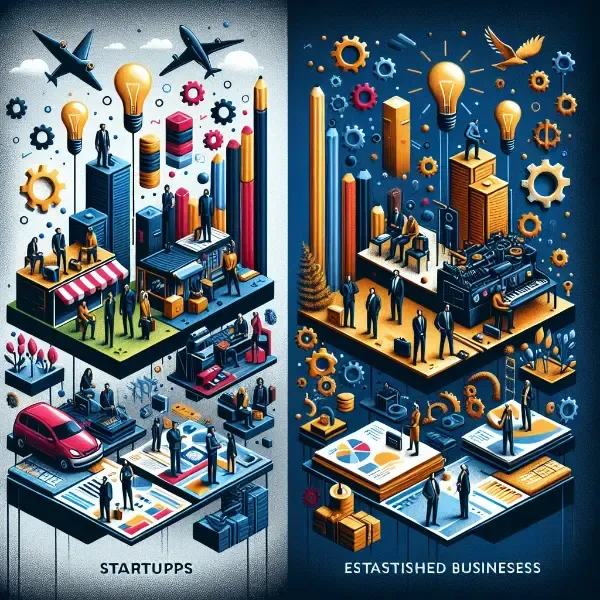
Mature organisations operate in a predictable and controlled way. They are more likely to refine proven processes than to experiment. This is visible in their priorities: startups can devote around 40% of their time to product development, while established companies are closer to 30%.
Microsoft builds stability by continuously refining its flagship solutions. This is not a lack of innovation, but a deliberate, measurable approach to risk.

Snapchat, in turn, launched with a bold idea and an aggressive growth pace. Ephemeral content changed the way people interact on social media and established the brand as a disruptor.
Both worlds are needed. Startups introduce radical innovation, while corporations provide scale, reliability and standardisation — together, they drive the development of the entire technology ecosystem.
Age, culture and appetite for risk
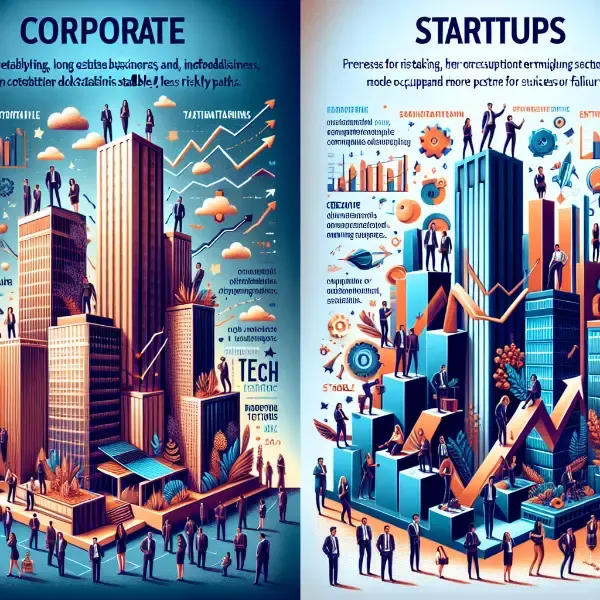
A company’s age shapes its culture and decision-making style. Mature organisations are, by definition, more conservative and inclined towards gradual improvements. Young companies are more likely to accept uncertainty, explore new business models and take risks in the name of speed.
This contrast is not a flaw in the system, but its strength. The collision of boldness and refinement creates a healthy dynamic of change — from creativity and courage, through resilience, to the continuous evolution of technologies that reach the mainstream.
Venture capital: fuel for growth
Venture Capital is fuel for startups playing for scale. According to Statista, global VC funding in 2020 reached around $300 billion — proof of how strongly investors support high innovation potential.
The stories of Uber and Spotify show how capital makes it possible to win markets quickly, build product and infrastructure, and hire key talent. However, VC expects speed, clear milestones and scalable economics.
- What VC provides: an injection of capital, access to networks, experience in scaling
- What it requires: a credible growth plan, measurable KPI, a competent team
- What to watch out for: equity dilution, pressure for speed, the need for mature corporate governance
How to operate as a founder without a technical background
- Define the problem and the product vision. Clearly describe who you are building for, what pain point you solve and why now
- Learn the basics. Take courses in web, mobile and cloud on Codecademy or Treehouse to better understand technical decisions
- Choose complementary capabilities. Consider a technical co-founder, a fractional CTO or a proven product studio to get started
- Start with an MVP. Build the smallest version that solves the key problem, test it with real users and iterate
- Use no-code and low-code. These tools shorten time to market and help validate hypotheses quickly
- Manage technical risk. Focus on simple architectures, ready-made components and cloud services, and take care of data security
- Set metrics and a feedback loop. Define the North Star Metric, monitor retention, activation, unit economics and learn from the data
- Plan the product, not just the features. Run discovery, map user journeys, prioritise the backlog in terms of business value
- Build culture and processes. Clear communication, accountability, fast decisions and experimentation cycles are the foundation of speed
- Prepare for conversations with VC. A coherent pitch, traction, milestones and a capital deployment plan increase your chances of securing funding
Summary
In the world of technology, it is not only code that wins, but above all vision, leadership and consistency in delivery. Startups and corporations play by different styles, but together they shape the market. If you have courage, learn quickly and build the right partnerships, the lack of a technical degree is not a barrier — it is often an advantage, because it forces you to focus on the customer’s problem and business value.
Need technology support?
Let’s talk about your project — from discovery to deployment.
Book a consultationWould you like to know more?
Explore other articles or let’s discuss your project
All articles Let’s design your AI application